
Turn your notes into flashcards—and drill the ones you miss
Use the notes you wrote in class or while reading. Confirm the transcript of any handwritten sections, publish study material and generate question-and-answer cards with missed-card retry rounds.
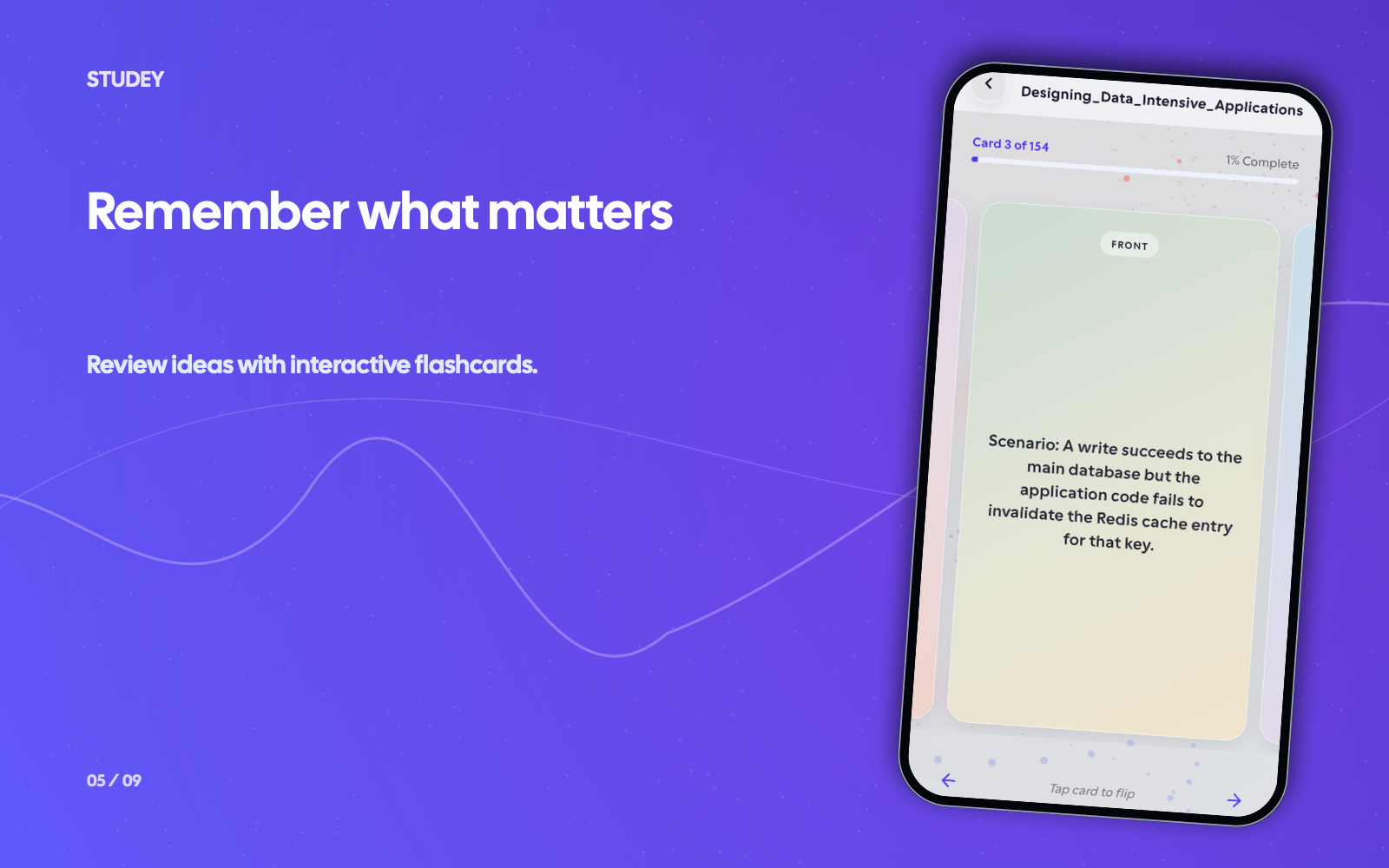
Write, confirm the transcript and practise active recall
Review handwriting before you generate practice questions.
- 1
Prepare your notes
Open your notebook. For handwritten stylus or Apple Pencil sections, request a transcript or enter one manually.
- 2
Review and process
Correct the text, confirm its accuracy and create study material. Process the material before making a deck.
- 3
Recall, self-grade and retry missed cards
Generate flashcards, answer before revealing the back, mark each card correct or incorrect and launch an incorrect-only round for the cards you missed.
Worked example
From source material to study outputs
Illustrative walkthrough showing how a single passage or topic flows into Studey’s study tools.
Reviewed Notebook Section — Organic Chemistry: SN1 vs. SN2 Mechanisms
“SN2 reactions occur in a single concerted step with backside attack, resulting in inversion of configuration (rate = k[Substrate][Nucleophile]). Polar aprotic solvents (e.g., acetone, DMSO) favor SN2 by leaving the nucleophile unsolvated.”
In the app, your original source stays open alongside generated study tools so you can verify terms, formulas and conditions.
Card 1 (Mechanism & Stereochemistry)
Front: What stereochemical outcome results from an SN2 backside attack at a chiral center? → Back: Inversion of configuration (100% inversion in a single concerted step).
Card 2 (Rate Law)
Front: Why is an SN2 reaction bimolecular? → Back: Both the substrate and nucleophile appear in the rate-determining step: rate = k[Substrate][Nucleophile].
Card 3 (Solvent Effect — Marked 'Missed')
Front: Why do polar aprotic solvents accelerate SN2 reactions? → Back: They do not hydrogen-bond strongly to the nucleophile, keeping it high in energy. (Added to your incorrect-only retry round).
Examples of what you can study
Use your course readings, work guides or personal notes. Here are a few examples.
Remember definitions and mechanisms
Use cards to practise terminology and reaction conditions from your reviewed notes. Check names and symbols carefully.
Isolate weak spots before an exam
Grade each card honestly during your first pass, then run a missed-card round so you spend your time on the prompts you got wrong.
Tools you can use with this source
Ask the tutor for an explanation or choose a tool to review what you’ve learned.
Note taking
Handwrite with an Apple Pencil or stylus, or type structured notes in Studey. Confirm handwriting transcripts and turn published versions into cited AI explanations, flashcards and quizzes.
Explore featureAI companion
Ask questions about your processed notes, PDFs, slides and documents. Verify answers with inline numbered citations, verbatim source excerpts and one-tap PDF page jumps.
Explore featureFlashcards
Create flashcards from reviewed notes, PDFs, slides and documents. Answer before flipping, self-grade recall and launch targeted rounds for missed cards.
Explore featureQuiz generator
Generate practice quizzes from reviewed notes, PDFs, slides and documents. Choose Easy, Moderate or Hard difficulty, question counts, timers and detailed answer explanations.
Explore featureQuestions about notes to flashcards
- Can I make flashcards from handwritten notes?
- Yes. Review a transcript of your handwritten sections, create study material from the confirmed text and process it. You can then generate flashcards from that version.
- Will flashcards change when I edit the notebook?
- No. A deck belongs to the published source version. Create and process an updated material to generate cards that include later edits.
- Do I need to check AI-generated cards?
- Yes. Compare the questions and answers with your notes, especially for technical terms, formulas and exceptions. A generated deck is not a guarantee of full exam coverage.
Try the learning journey.
Take a sample quiz, flip a flashcard or try the simulated tutor chat.